





Skip Navigation

BrainFacts.org

A PUBLIC INFORMATION
INITIATIVE OF:

  • Kavli
  • Gatsby
  • SfN

Sensory Illusions

Now you see it, now you don’t. Tricks and illusions are not just for magicians. Brain researchers use these tools to learn about sensory perception.

More »

Image of the Week: Directing Traffic

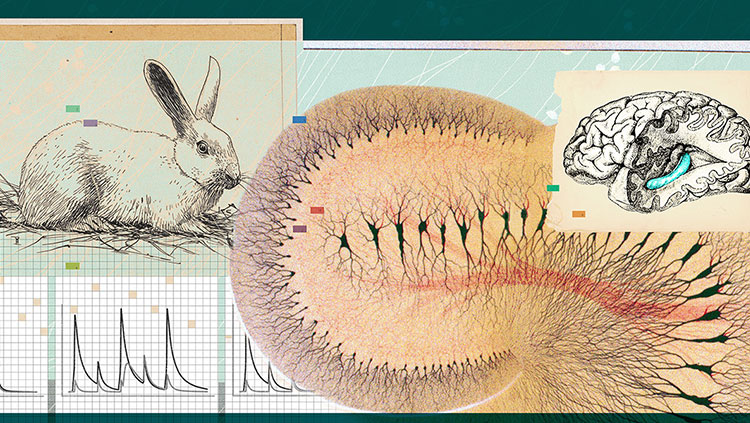
A gene controls neuronal traffic in the assembly of this electrical circuit.

More »

Neuroeconomics: A Window into Human Behavior

Understanding the drivers behind individual and group decision-making may lead to insights into the economy.

More »

Disease-Causing Proteins

Understanding the cause of “mad cow” disease and related conditions resulted in a fundamental shift in what scientists understood about proteins in brain disease.

More »

Image of the Week: A Slug's Life

Same neurons, different behaviors: How two slugs with similar brains can swim so differently.

More »

Discoveries

The Cocktail Party Problem

Source: Society for Neuroscience
Despite the swanky name, the cocktail party problem has nothing to do with martinis and hors d’oeuvres. It’s a term scientists use to refer to the brain’s ability to tune in to a single voice.

Jeff Hawkins: How Brain Science Will Change Computing

Source: TED
Treo creator Jeff Hawkins urges us to take a new look at the brain.

The Moral Brain

Source: Society for Neuroscience
Scientists don’t claim to know how people determine right from wrong. However, they can study how the brain responds when an individual judges another’s actions.

Michelle Freund, NIMH Project Officer, on the significance of CLARITY

Source: National Institute of Mental Health
Project officer Michelle Freund, Ph.D., of the NIMH Division of Neuroscience and Basic Behavioral Science, explains the significance of CLARITY, a breakthrough method for analyzing the brain.

Disease-Causing Proteins

Source: Society for Neuroscience

Understanding the cause of “mad cow” disease and related conditions resulted in a fundamental shift in what scientists understood about proteins in brain disease.

Recent Neuroscience in the News

Eye-Tracking Software May Reveal Autism and other Brain Disorders

Source: Scientific American
Date: 18 June 2013

Can capturing eye movements help clinicians make diagnoses of mental and neurological disorders, such as autism, ADHD, Parkinson’s disease and more?


Going Wireless and Restoring Memories: The Incredible Future of Brain Implants

Source: Popular Mechanics
Date: 17 June 2013

At the Global Future 2045 conference in New York City, speakers explained how scientists are exploiting electrical connections to blur the line between man and machine—and the accomplishments so far are incredible. 


Cheating Ourselves of Sleep

Source: New York Times
Date: 17 June 2013
Some of the most insidious effects of too little sleep involve mental processes like learning, memory, judgment and problem-solving. 

BrainFacts.org on Facebook

Follow BrainFacts.org on Twitter

Tell Us What You Think