
How People at High Risk for Alzheimer’s Are Cultivating Community
- Published28 Oct 2026
- Author Mackenzie Williams
- Source BrainFacts/SfN

Julie Gregory’s efforts to build a community dedicated to reducing Alzheimer’s risk began with a prescription for an EpiPen. In 2012, the 50-year-old Gregory was diagnosed with an immune condition, mast cell activation syndrome, because of an ongoing reaction to an unknown irritant; hence the EpiPen. When the allergy-like symptoms didn’t improve with antihistamines, one of her physicians suggested she take a 23andMe genetic test in the hopes of finding answers.
The results of that test upended Gregory’s life. Instead of gaining insight into her current health issues, the results revealed she carried a genetic variant, APOE4, which dramatically increases her risk for developing late-onset Alzheimer’s disease.
Keen to understand what this meant, she began combing through the limited information she could find on APOE4 and its association with developing Alzheimer’s over the age of 65. Turning to an online forum through 23andMe, she connected with fellow carriers who discussed their test results and offered each other emotional support.
A year later, Gregory and a few other members established a new digital community: APOE4.info, a patient advocacy group for APOE4 carriers. The site’s discussion boards offer the APOE4 community refuge and advice. Connecting regularly over Zoom, contributors swap information about Alzheimer’s and APOE4. The platform encourages members to find solidarity as they navigate the medical reality of carrying this variant and work to keep up with the latest research and clinical trials pertaining to it.
“I recognized we were sitting on a treasure trove of information ... created by people that had skin in the game,” Gregory said. “Essentially, patients searching for their own cure.
What APOE4 Means for Carriers
The increased risk Gregory and her fellow APOE4 carriers possess arises from a subtle but specific structural variation in a fat-binding protein called apolipoprotein E, or ApoE for short. This protein enables cholesterol transport throughout the body.
In the central nervous system, ApoE is predominantly produced by specialized support cells called astrocytes and facilitates the transport of cholesterol into neurons. While too much cholesterol can build up in and damage blood vessels, cholesterol is vital for healthy cell membranes and serves a building block for critical hormones.
The gene encoding the instructions for producing ApoE comes in three versions called alleles: APOE2, APOE3, and APOE4. These alleles differ from each other only slightly, and result in proteins identical except for one or two amino acid building blocks. It’s enough, however, to change the shape and efficiency of ApoE.
“Only 2% of the world's population has a genetic risk as high as I do for Alzheimer’s, other dementias, and cardiovascular disease.” — Julie Gregory
Unfortunately, the protein encoded by APOE4 doesn’t transport fats as efficiently as the proteins made from the other variants. It also affects other processes linked to Alzheimer's, including inflammation and how the brain clears amyloid.
Everyone possesses two copies of APOE in their DNA — one inherited from each parent. As a result, there are six possible combinations of the variants. Those who have a single copy of APOE4 are about two to three times as likely to develop Alzheimer's as people with two copies of APOE3, the most common variant. For those with two copies of APOE4, the risk rises to about 15-fold, although estimates vary with ancestry, sex, and age. Gregory inherited two.
“Only 2% of the world's population has a genetic risk as high as I do for Alzheimer’s, other dementias, and cardiovascular disease,” Gregory said.
In 1993, researchers at Duke University identified the link between APOE4 and late-onset Alzheimer's. In a study of 42 families affected by the disease, the estimated risk of developing Alzheimer's rose from about 20% in people with no APOE4 copies to about 90% in those with two. And the average age at onset dropped from 84 to 68.
More than three decades later, however, experts still can’t fully explain this strong connection. Genetic testing assesses risk, but it’s not a diagnosis. Not everyone with two APOE4 copies develops Alzheimer's dementia. Studies estimate that roughly half to 60% do so by age 85. Plus, many reach old age without dementia, although most show Alzheimer's-related changes in the brain. For those who do develop the disease, researchers are zeroing in on how being a carrier may correlate with the toxic buildup of proteins linked to Alzheimer’s.
In 2024, a large study found nearly all people with two APOE4 copies show Alzheimer's-related changes, reflected in their spinal fluid or brain scans, by age 65. These changes appeared years before symptoms occurred, and earlier than those with two APOE3 copies, leading the researchers to propose that carrying two APOE4 copies represents a distinct genetic form of Alzheimer's. Biomarker tests, including blood tests, or brain scans looking for signs of amyloid or tau buildup, can detect Alzheimer's-related changes before symptoms appear. But people without symptoms of Alzheimer’s don’t typically receive this type of testing beyond the context of clinical research studies, and it’s not yet clear whether acting on their results can prevent dementia. Many APOE4 carriers take part in prevention studies that include this testing.
Experts generally advise APOE4 carriers, like anyone concerned about dementia, to manage heart-health risk factors such as cholesterol, blood pressure, and blood sugar, and to stay physically active. Some also suggest limiting refined carbohydrates and eating plenty of fresh produce and whole grains, though no diet has yet been proven to prevent Alzheimer's in APOE4 carriers. APOE4.info members regularly share and discuss new research related to diets, but people should always consult a physician before making major changes to what they eat.
Pulling Back the Curtain on APOE4’s Role in the Brain
Since the discovery of the APOE4-Alzheimer’s link, researchers have worked toward understanding what the ApoE protein does in the brain and developing potential drugs designed specifically for APOE4 carriers.
Matthew Stremlau leads the E4 project at the Johns Hopkins Drug Discovery program. His team wants to understand how the APOE4 gene influences the way cells accumulate fat. They hope to find a way to interfere with this process using a small molecule drug, which works by targeting specific biological processes within cells.
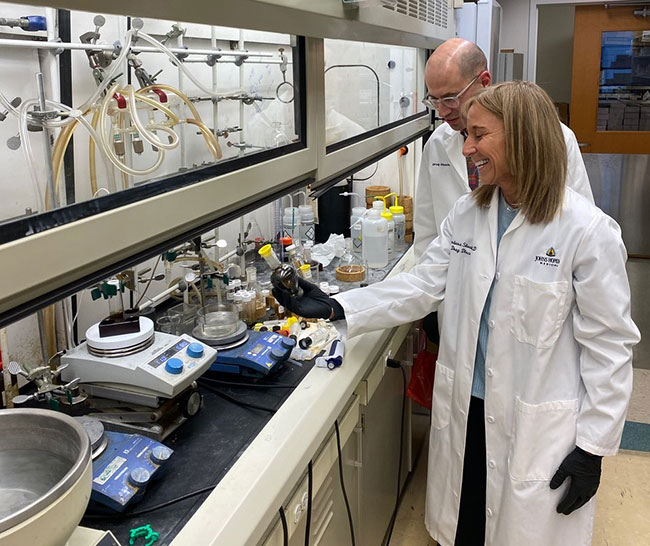
In the case of APOE4 carriers, the drug would modify the ApoE protein the APOE gene codes for and interfere with its ability to transport cholesterol. The goal is to counteract the elevated cardiovascular and Alzheimer’s risks APOE4 poses by making this variant behave more like it does in the brains of people who carry APOE3 or APOE2.
“Even if we don't find a drug that modulates APOE4's behavior, maybe we find something that binds specifically to APOE4, and then we can use it as a tool to understand what APOE4 is doing in the brain,” Stremlau said.
Meanwhile, Joel Blanchard’s lab at the Icahn School of Medicine at Mount Sinai is developing 3D “mini brain” (organoid) models derived from stem cells to understand how genetic risk factors like APOE4 influence the brain.
These stem cells contain the genetic information of the people they were derived from, including which APOE variant they carry. He compared the technology to black box recording devices installed on airplanes, which are retrieved and used during investigations following plane crashes.
“With our mini brains in the lab, we can replay the events of Alzheimer's disease, understand where the brain diverged from normal in APOE4 carriers, and then try to develop therapies around the mechanisms that made it diverge from normal aging,” Blanchard said.
Based on their research, Blanchard and his team believe APOE4 carriers may produce myelin sheaths — the fatty layer surrounding and insulating axons — differently compared to people with other APOE variants. They suspect APOE4 is linked to less myelin production, which changes how cholesterol accumulates in the brain. He said one drug designed to boost myelin production could potentially improve brain health among APOE4 carriers.
Work like this is crucial because APOE4 carriers have even more limited treatment options compared to non-carriers with Alzheimer’s. There is no cure for the disease, but two medications on the market can slow its progression. The U.S. Food and Drug Administration (FDA) warns people with two APOE4 copies, however, may be at an elevated risk for brain swelling and bleeding when taking those medications compared to those who aren’t carriers.
“We want the Food and Drug Administration and other policy makers [to be aware] that APOE4 is a separate biological entity,” Gregory said. “What might work for the generic Alzheimer's crowd doesn't work for us.”

As a public charity, APOE4.info now consists of an estimated 15,000 members across 15 countries. The organization advocates for developing drugs designed specifically for APOE4 carriers, and for funding clinical trials involving carriers. Today, Gregory said the organization has connected with several pharmaceutical companies to inform the community about emerging potential drugs and offer members the chance to ask their questions directly to researchers.
Both the APOE4 community and scientists envision a future where Alzheimer’s treatments aren’t marketed as a catch-all but rather tailored to meet individual needs based on a culmination of factors, including which APOE variant they carry.
“My hope is that the APOE4 carriers who come after me will lead long, disease-free lives,” Gregory said.
About the Author

Mackenzie Williams is a DC-based science writer. She writes about neurodegenerative diseases such as Alzheimer’s and genetics.
CONTENT PROVIDED BY
BrainFacts/SfN
References
Blanchard, J. W., Akay, L. A., Davila-Velderrain, J., von Maydell, D., Mathys, H., Davidson, S. M., Effenberger, A., Chen, C. Y., Maner-Smith, K., Hajjar, I., Ortlund, E. A., Bula, M., Agbas, E., Ng, A., Jiang, X., Kahn, M., Blanco-Duque, C., Lavoie, N., Liu, L., Reyes, R., … Tsai, L. H. (2022). APOE4 impairs myelination via cholesterol dysregulation in oligodendrocytes. Nature, 611(7937), 769–779. https://doi.org/10.1038/s41586-022-05439-w
Budny, V., Ruminot, I., Wybitul, M., Treyer, V., Barros, L. F., & Tackenberg, C. (2025). Fueling the brain - the role of apolipoprotein E in brain energy metabolism and its implications for Alzheimer's disease. Translational Psychiatry, 15(1), 316. https://doi.org/10.1038/s41398-025-03550-w
Corder, E. H., Saunders, A. M., Strittmatter, W. J., Schmechel, D. E., Gaskell, P. C., Small, G. W., Roses, A. D., Haines, J. L., & Pericak-Vance, M. A. (1993). Gene dose of apolipoprotein E type 4 allele and the risk of Alzheimer's disease in late onset families. Science, 261(5123), 921–923. https://doi.org/10.1126/science.8346443
Fernández-Calle, R., Konings, S. C., Frontiñán-Rubio, J., García-Revilla, J., Camprubí-Ferrer, L., Svensson, M., Martinson, I., Boza-Serrano, A., Venero, J. L., Nielsen, H. M., Gouras, G. K., & Deierborg, T. (2022). APOE in the bullseye of neurodegenerative diseases: impact of the APOE genotype in Alzheimer's disease pathology and brain diseases. Molecular Neurodegeneration, 17(1), 62. https://doi.org/10.1186/s13024-022-00566-4
Fortea, J., Pegueroles, J., Alcolea, D., Belbin, O., Dols-Icardo, O., Vaqué-Alcázar, L., Videla, L., Gispert, J. D., Suárez-Calvet, M., Johnson, S. C., Sperling, R., Bejanin, A., Lleó, A., & Montal, V. (2024). APOE4 homozygozity represents a distinct genetic form of Alzheimer's disease. Nature Medicine, 30(5), 1284–1291. https://doi.org/10.1038/s41591-024-02931-w
Kaiser, Jocelyn. (2024). The burden of a gene. Science. https://www.science.org/content/article/insights-notorious-alzheimer-s-gene-fuel-hope-staving-dementia
National Institutes of Health. (2024). Study defines major genetic form of Alzheimer’s disease. https://www.nih.gov/news-events/nih-research-matters/study-defines-major-genetic-form-alzheimers-disease
U.S. Food and Drug Administration. (2024). FDA approves treatment for adults with Alzheimer's Disease. [Press release]. https://www.fda.gov/drugs/news-events-human-drugs/fda-approves-treatment-adults-alzheimers-disease
U.S. Food and Drug Administration. (2026). FDA Approves First At-home Starting Dose for Alzheimer’s Disease Treatment. [Press release]. https://www.fda.gov/drugs/news-events-human-drugs/fda-approves-first-home-starting-dose-alzheimers-disease-treatment