Bilingualism: Two Languages, One Mind
- Published12 Jan 2026
- Source BrainFacts/SfN
From behavioral tests to brain scans, scientists are uncovering differences between people who are bilingual, or fluent in two languages, compared to those who are monolingual, or fluent in one language.
Learn how bilingual brains and monolingual brains differ based on how the two groups differently utilize their minds to make sense of information.
This is a video from the 2025 Brain Awareness Video Contest.
Created by Sohee Kim
CONTENT PROVIDED BY
BrainFacts/SfN
Transcript
Welcome to the language floor of the Archive. You must be the guest that we've been preparing for! Your guides are running slightly late, I'm afraid.
It's very present in our everyday lives, isn't it? Language. I saw in your application for the program that you were specifically interested in... bilingualism?
Considering how many people now know at least two languages, it's gaining more interest these days. Believe me, I've seen articles about raising bilingual babies and how it—
L1: Hey, stop right there!
Ah, I got ahead of myself. I'll let L1 and L2 walk you through all that.
L2: We're on a bit of a time crunch, so we'll get right to it. If you will, L1?
L1: Of course, L2! So, there are two main models to explain how the bilingual mind works.
The first one is the hierarchical model, and that's where me and L2 got our names from. The basic premise of this model is that L2 needs L1 to convey concepts. In the case of monolinguals, this model is simpler.
The second one is the Inhibitory Control Model. It's different from the previous one as it considers language as an action and that it can be controlled. Let's say that a bilingual person wants to say something in their second language.
To produce a sentence in a native language, little control is needed from outside of the bilingual lexico-semantic system. But to speak a second language, the situation picked up on by these two would tell the Supervisory Attentional System [SAS] that it would be more appropriate to speak in a second language. The SAS pushes down the instinctive response to use a native language for the second language to be used.
L2: The models presented by L1 suggest that there would be differences between bilinguals and monolinguals. But can we say that the bilingual brain differs from the monolingual one?
Long story short, yes and no.
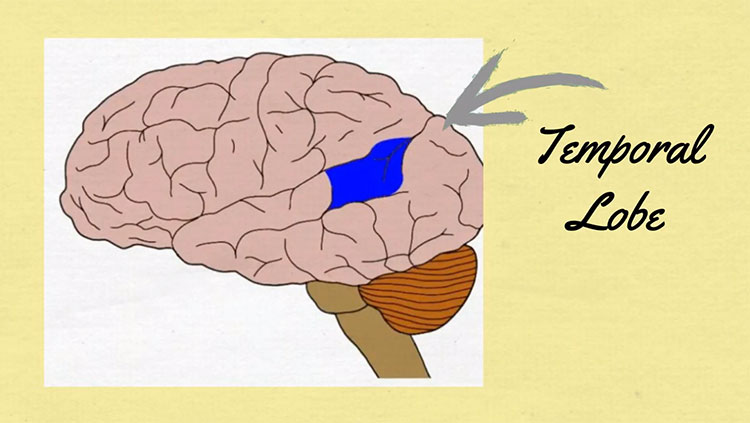
Here are the main language areas of the brain. Most of it is heavily in the left side, and between bilinguals and monolinguals, the same language parts of the brain are active when doing all sorts of language tasks, such as reading and naming objects.
But there have been some differences in the structure of the brain between bilinguals and monolinguals.
Bilinguals who have learnt their second language at a younger age were found to have more neuronal connections in the inferior parietal cortex, which is a part of the brain that is related to many mental processes, such as attention.
L1: With L2, I think we've both explained the general background for what we really wanted to get into. Is bilingualism an advantage? It's been an ongoing debate, but with the Inhibitory Control Model in mind, we can suggest, yes — as controlling two languages would allow for bilinguals to be better at controlling competing information outside of the language field.
L2: There is evidence to support this idea. And that evidence comes from a task called the Flanker task, where people were asked to respond to the direction of the red arrow. In the case of the congruent trial, there's no need for the SAS — which is responsible for control — to do anything, because the instinct to respond to the right doesn't need to be suppressed. In the incongruent trial, the SAS has to suppress the initial response of choosing right.
Behaviorally, it was found that bilinguals were quicker to respond to the incongruent trials and made less mistakes.
L1: And let's not forget the differences in brain activities!
L2: I was getting to that, L1. Using the same task and a brain scanning technique, it was found that in the incongruent trials, monolinguals used more of the temporal and parietal networks. Bilinguals, on the other hand, relied more on the frontal regions, which are very commonly associated with the control and organization of planning.
It's very present in our everyday lives, isn't it? Language. I saw in your application for the program that you were specifically interested in... bilingualism?
Considering how many people now know at least two languages, it's gaining more interest these days. Believe me, I've seen articles about raising bilingual babies and how it—
L1: Hey, stop right there!
Ah, I got ahead of myself. I'll let L1 and L2 walk you through all that.
L2: We're on a bit of a time crunch, so we'll get right to it. If you will, L1?
L1: Of course, L2! So, there are two main models to explain how the bilingual mind works.
The first one is the hierarchical model, and that's where me and L2 got our names from. The basic premise of this model is that L2 needs L1 to convey concepts. In the case of monolinguals, this model is simpler.
The second one is the Inhibitory Control Model. It's different from the previous one as it considers language as an action and that it can be controlled. Let's say that a bilingual person wants to say something in their second language.
To produce a sentence in a native language, little control is needed from outside of the bilingual lexico-semantic system. But to speak a second language, the situation picked up on by these two would tell the Supervisory Attentional System [SAS] that it would be more appropriate to speak in a second language. The SAS pushes down the instinctive response to use a native language for the second language to be used.
L2: The models presented by L1 suggest that there would be differences between bilinguals and monolinguals. But can we say that the bilingual brain differs from the monolingual one?
Long story short, yes and no.
Here are the main language areas of the brain. Most of it is heavily in the left side, and between bilinguals and monolinguals, the same language parts of the brain are active when doing all sorts of language tasks, such as reading and naming objects.
But there have been some differences in the structure of the brain between bilinguals and monolinguals.
Bilinguals who have learnt their second language at a younger age were found to have more neuronal connections in the inferior parietal cortex, which is a part of the brain that is related to many mental processes, such as attention.
L1: With L2, I think we've both explained the general background for what we really wanted to get into. Is bilingualism an advantage? It's been an ongoing debate, but with the Inhibitory Control Model in mind, we can suggest, yes — as controlling two languages would allow for bilinguals to be better at controlling competing information outside of the language field.
L2: There is evidence to support this idea. And that evidence comes from a task called the Flanker task, where people were asked to respond to the direction of the red arrow. In the case of the congruent trial, there's no need for the SAS — which is responsible for control — to do anything, because the instinct to respond to the right doesn't need to be suppressed. In the incongruent trial, the SAS has to suppress the initial response of choosing right.
Behaviorally, it was found that bilinguals were quicker to respond to the incongruent trials and made less mistakes.
L1: And let's not forget the differences in brain activities!
L2: I was getting to that, L1. Using the same task and a brain scanning technique, it was found that in the incongruent trials, monolinguals used more of the temporal and parietal networks. Bilinguals, on the other hand, relied more on the frontal regions, which are very commonly associated with the control and organization of planning.