Like Other Senses, Smell Receptors Map Onto Mouse Brain
- Published9 Jul 2026
- Author Bella Isaacs-Thomas
- Source BrainFacts/SfN
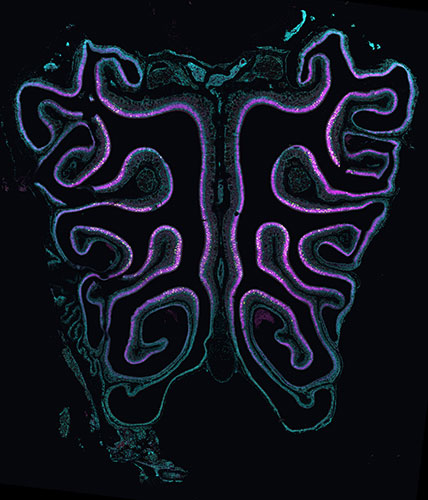
This cross section was taken from a mouse’s nose, illuminating its olfactory sensory neurons — which assess smells and send this information to the brain — in cyan blue. All other cells are pictured in magenta. Of the more than 1,000 different types of receptors for smell, each neuron only expresses one.
Researchers previously believed the distribution of these receptors was more or less random across the nose. But two studies involving mice published in the journal Cell suggest smell receptors are distributed in an organized system, arranged by overlapping stripes of neurons throughout the nasal epithelial tissue.
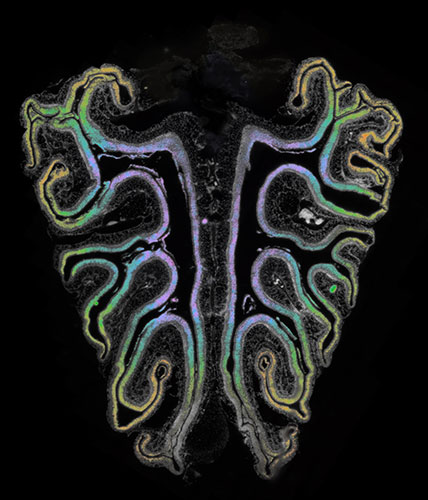
This mouse nose cross section showcases the predictable organization of neurons, which are color coded based on the groups of smell receptors they express throughout the nasal epithelium. The layout of these stripes maps directly to smell maps in the brain’s olfactory bulb. This mirrored layout is how other sensory systems, including vision and touch, are structured in both mice and humans.
Whether the olfactory system in humans displays the same organization is yet to be determined, but these findings indicate our existing understanding of olfaction in mice has so far been incomplete.
About the Author
.jpg)
Bella is the Staff Writer and Editor for BrainFacts. She previously worked as a digital science reporter at PBS NewsHour, where she was named a fellow in the 2022-2023 class of the National Science-Health-Environment Reporting Fellowships (SHERF) and earned a 2021 D.C. Science Writers Association Newsbrief Award for writing. She graduated from the University of Michigan with a bachelor's degree in 2018.
CONTENT PROVIDED BY
BrainFacts/SfN
References
Brann, D. H., Tsukahara, T., Tau, C., Kalloor, D., Lubash, R., Kannan, L. T., Klimpert, N., Kollo, M., Escamilla-Del-Arenal, M., Bintu, B., Schaefer, A., Fleischmann, A., Bozza, T., & Datta, S. R. (2026). A spatial code governs olfactory receptor choice and aligns sensory maps in the nose and brain. Cell, 189(11), 3358–3379.e30. https://doi.org/10.1016/j.cell.2026.03.051