How Pesticide Exposure Can Rewire Children’s Brains
- Published17 Mar 2026
- Author Sanket Jain
- Source BrainFacts/SfN
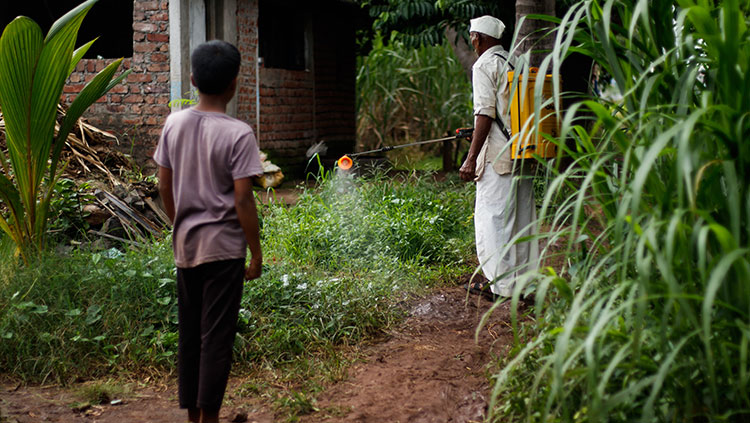
Balaji Tasgave thought his child wasn’t disciplined enough. At first, he dismissed it as a normal childhood phase, believing his 12-year-old son Ayush would eventually do better with reading and writing in school. But his confidence wavered when the schoolteacher raised concerns, warning that Ayush’s struggles were not common for his age.
“Many of my friends don’t know how to read and write,” said Ayush, looking outside a tin-roofed house. His home in the Jambhali village of Western India’s Maharashtra state is surrounded by the bitter and stinging smell of 14-foot-tall sugarcane fields. For the Tasgave family, that smell is no longer just unpleasant. It is a constant reminder of the chemicals drifting into their home, and the possible source of Ayush’s struggles in school.
His declining performance, troubles with writing, waning attention span in class, and difficulty with coordination all suggest an underlying neurological issue, according to a local doctor who has seen Ayush. He confessed to feeling anxious, and the frequent complaints from teachers only add to his stress. When every attempt at intervention failed, Tasgave wondered if something beyond his control was responsible.
At a young age, Ayush could name over 10 pesticides. “Each day after school, he tosses his bag and rushes to the nearby fields, spending at least two hours observing farmers spraying without masks or protective gear,” shared Tasgave. Living amid pesticide-sprayed fields, the Tasgave family now worries about possible irreversible effects. Could his son’s learning challenges be linked to the activities in the farmlands near his house?
This suspicion is not unfounded, as emerging research from different countries is showing how prenatal and early-life exposure to commonly used chemicals in pesticides like organophosphates pose a severe threat to children’s neurodevelopment.
Organophosphates disrupt how nerves work. They primarily block an enzyme called acetylcholinesterase, which prevents nerve cells from firing nonstop by breaking down acetylcholine, a brain chemical that carries messages between nerve cells. When this enzyme is blocked, acetylcholine can excessively build up, causing nerve signals to keep firing without shutting off. This chain of events is toxic and deadly to pests, as designed — but at high doses, this can cause poisoning in humans and animals. However, scientists believe even low, early-life exposures can interfere with brain development.
From India’s fields to Africa, Europe, and the U.S., researchers are uncovering how exposure to pesticides during pregnancy and early childhood can leave lasting effects on learning, memory, and behavior. Decades-long cohort studies and brain scans are showing these exposures leave detectable traces on the brain’s activity.
How Pesticides Rewire the Developing Brain
Early skills such as attention, memory, and information processing form the foundation for later learning. In a study published in June 2025, scientists evaluating babies in Thailand found that those exposed to organophosphates in utero struggled to remember objects in images — such as picture of faces — they had seen repeatedly at seven months old. This suggests even in infancy, these babies required more time to learn new information. The deficits continued at 18 months old.
The study’s lead author, Nancy Fiedler, a professor at the Rutgers School of Public Health and Deputy Director of the Environmental and Occupational Health Sciences Institute, told BrainFacts research from animal models has given scientists insight into how pesticides can influence brain development in utero.
“Pesticides cross the placenta, and depending on the stage of development, will affect dopamine and serotonin neurotransmitter systems,” said Fiedler, noting only a couple of the many neurotransmitter systems pesticides can disrupt. These changes in brain chemicals can affect how different brain areas, like the parietal and frontal lobes, form connections with each other, she added. These brain regions are crucial for paying attention, filtering out distractions, and learning and remembering new information. When their development is disrupted, it can make it harder for children to focus, process, and store new information.

Balaji Tasgave observed that pesticide use has steadily increased over the past three decades, a trend evident in global data. From 1990 to 2022, the usage doubled to 3.7 million metric tons. Scientists have studied similar exposures elsewhere. In northern Manhattan and the South Bronx, they followed 270 children whose mothers were exposed to chlorpyrifos (CPF), a widely used organophosphate. Higher prenatal CPF exposure was associated with long-term changes in brain development, including weaker movement and lower overall brain activity.
Studies indicate these risks can last into adulthood. In a study from California, researchers measured pesticide exposure during pregnancy and early childhood, then scanned participants’ brains at age 18. Individuals with higher prenatal exposure to organophosphates showed subtle differences in memory and thinking.
Sharon Sagiv, an environmental epidemiologist and associate adjunct professor at the UC Berkeley School of Public Health, who led the study, said scientists still don’t fully understand how early-life exposure to organophosphate pesticides affects the brain later. However, they speculate organophosphates interfere with brain chemicals such as dopamine and serotonin, which are crucial for regulating mood, attention, and aspects of learning and decision-making in the frontal cortex.
According to Sagiv, these pesticides might slow the growth of nerve fibers that help brain cells communicate. They may increase stress and inflammation within brain cells and disrupt the delicate balance of calcium inside cells, which is crucial for the brain to function properly. However, scientists are also investigating how exposure might turn on or off certain genes that could affect brain development.
When Risks Continue Into Adulthood
Follow-up studies have shown the lasting effects of prenatal exposure on children’s cognitive abilities and intelligence. Fiedler noted evidence from human and animal studies suggests the changes seen in infants and young children exposed in utero can continue to affect them into childhood, adolescence, and adulthood.
“Some effects may persist based on how disruptions during early development due to pesticide exposures interfere with the building blocks necessary for more complex cognitive demands,” she added.
Research also links pesticide exposure to neurodegenerative diseases later in life. Evidence from study participants in Minneapolis suggests that early-life exposure to well water as a primary drinking source and proximity to agricultural fields can increase the risk of developing Parkinson’s later in life. This underscores the importance of preventive measures for families living near farms.

Paul Laurienti, director of the Laboratory for Complex Brain Networks and professor at Wake Forest University School of Medicine, said reducing exposure “means staying out of fields and ensuring family members do not bring pesticides home on their bodies and clothing.”
But for some, staying away from the fields is not so simple. People in low-income and marginalized communities are more likely to live near farming fields, where pesticide use is heaviest. Affordable housing is often concentrated in areas where protective measures and enforcement are weak.
Beyond preventive measures, experts emphasize the importance of early stimulation for children who have already been exposed. “Enriched environments beginning as early as possible can help mitigate adverse effects of prenatal exposure,” explained Fiedler. Activities such as interactive reading and stimulating toys during infancy and early childhood that encourage problem-solving, motor coordination skills, such as blocks, puzzles, shape sorters, and stacking games can support brain development and mitigate some of the adverse effects of exposure.
Fiedler warned that if pesticide use continues at this pace, it could limit children’s potential, especially for those who have fewer resources to help them overcome adverse effects.
The danger is mounting. Balaji Tasgave watched the sugarcane fields around his home and said, “I don’t see pesticide use going down anytime soon.”
“I know pesticides are harmful, but I never imagined they might even affect our brains,” Tasgave said, watching his son run towards the fields.
About the Author

Sanket Jain is an award-winning independent journalist and documentary photographer based in India. He reports from remote regions often overlooked in the global media, focusing on the intersection of climate change, public health, and social justice. For the past eight years, he has been documenting stories of rural India.
CONTENT PROVIDED BY
BrainFacts/SfN
References
Fiedler, N., Nimmapirat, P., Sullivan, M. W., Promduang, W., Chaikittipornlert, N., Prapamontol, T., Naksen, W., Panuwet, P., Barr, D. B., Baumert, B. O., Ohman-Strickland, P., & Suttiwan, P. (2025). A birth cohort observational study to assess the association of prenatal biomarkers of organophosphates with visual attention, recognition memory and information processing among Thai infants. Environmental Research, 274, 121197. https://doi.org/10.1016/j.envres.2025.121197
Food and Agriculture Organization of the United Nations. (2024, July 16). Pesticides use and trade. 1990–2022. Statistics; FAO. https://www.fao.org/statistics/highlights-archive/highlights-detail/pesticides-use-and-trade-1990-2022/en
Hernández, A. F., Romero-Molina, D., Gonzalez-Alzaga, B., López-Flores, I., & Lacasaña, M. (2025). Changes in molecular biomarkers of neurotoxicity in newborns following prenatal exposure to organophosphate compounds. Chemosphere, 374, 144204. https://doi.org/10.1016/j.chemosphere.2025.144204
Moses, J., Criswell, S., Racette, B., & Krzyzanowski, B. (2024). Early Life Exposure to Pesticides and Well Water and Risk of Developing Parkinson’s Disease Later in Life (P8-3.013). Neurology, 102. https://doi.org/10.1212/wnl.0000000000205108
Mwakalasya, W. N., Mamuya, S. H., Manji, K., Moen, B. E., & Aiwerasia Vera Ngowi. (2025). 57 Prenatal pesticide exposure impairs social-emotional and executive function performance in children aged 4-6 years. Occupational and Environmental Medicine 2025;82:A26. https://doi.org/10.1136/oemed-2024-epicohabstracts.57
Paul, K. C., Krolewski, R. C., Lucumi Moreno, E., Blank, J., Holton, K. M., Ahfeldt, T., Furlong, M., Yu, Y., Cockburn, M., Thompson, L. K., Kreymerman, A., Ricci-Blair, E. M., Li, Y. J., Patel, H. B., Lee, R. T., Bronstein, J., Rubin, L. L., Khurana, V., & Ritz, B. (2023). A pesticide and iPSC dopaminergic neuron screen identifies and classifies Parkinson-relevant pesticides. Nature Communications, 14, 2803. https://doi.org/10.1038/s41467-023-38215-z
Peterson, B. S., Sahar Delavari, Bansal, R., Siddhant Sawardekar, Gupte, C., Andrews, H., Hoepner, L. A., Garcia, W., Perera, F., & Rauh, V. (2025). Brain Abnormalities in Children Exposed Prenatally to the Pesticide Chlorpyrifos. JAMA Neurology. https://doi.org/10.1001/jamaneurol.2025.2818
Soni, M., Chen, H., Cepeda, M. J., Berenson, L., Smith, S., Anderson, K. A., Quandt, S. A., Arcury, T. A., Laurienti, P. J., & Burdette, J. H. (2025). A longitudinal study comparing the impact of pesticide exposure on cognitive abilities of Latinx children from rural farmworker and urban non-farmworker families. Neurotoxicology and Teratology, 107450. https://doi.org/10.1016/j.ntt.2025.107450
US Environmental Protection Agency. (2025). Ingredients Used in Pesticide Products: Chemically-related Groups of Active Ingredients. https://www.epa.gov/ingredients-used-pesticide-products/chemically-related-groups-active-ingredients