ICYMI: In a First, China Approves Brain Implant for Commercial Use
- Published2 Apr 2026
- Author Bella Isaacs-Thomas
- Source BrainFacts/SfN
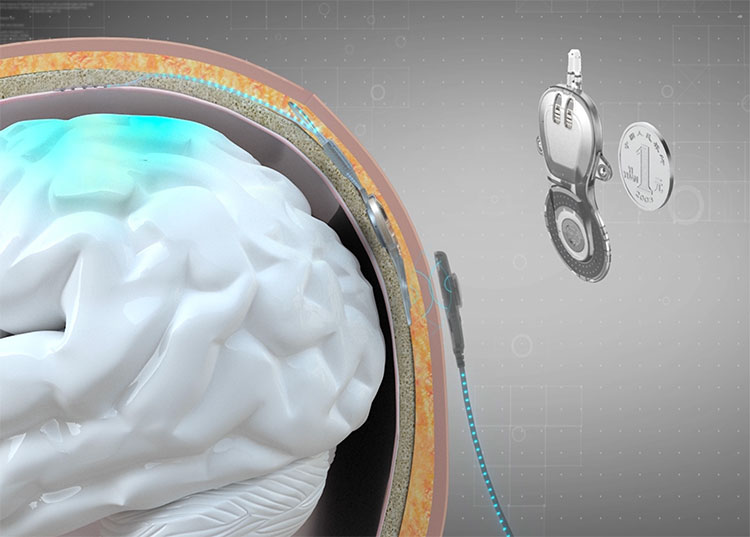
China became the first country to allow a brain-computer interface (BCI) to reach the public market. The device, called NEO, is designed for people living with paralysis, restoring their ability to grasp objects with their hands. Eligible users must be between 18 to 60 with partial paralysis resulting from injury to the neck portion of the spinal cord, according to Nature, but who maintain some ability to move their upper arms. NEO was developed by Neuracle Medical Technology in Shanghai, China, and was approved by China’s national drug and medical device regulator on March 13.
This BCI sits inside the skull directly above the brain’s primary sensorimotor cortex. It detects brain signals, which are decoded by a computer to control a robotic glove. A preprint published in 2025 from the team behind NEO, which has not been peer reviewed, said a patient with quadriplegia involved in testing the device successfully used it at home to perform tasks like moving objects, eating, and drinking over the course of nine months.
Big Picture: NEO is the first BCI to achieve approval for commercial use in any country. Experts across the globe are working in partnership with companies and universities to develop other BCIs aimed at restoring users’ ability to engage with the world around them. Some of these devices enable various types of movement, while others offer novel approaches to communication. Designing this technology and ensuring it’s safe and effective for users requires ample time and funding.
Read More: China approves brain chip to treat paralysis — a world first. Nature
More Top Stories
- New research suggests there’s no evidence marijuana eases symptoms of anxiety, PTSD, anorexia nervosa, or psychotic disorders. Scientific American
- Two patients with paralysis successfully communicated via “typing” on a virtual keyboard using an experimental BCI designed to record and translate attempted finger movements into letters. STAT
- Experiencing vivid dreams may make us wake up feeling like we had a notably deep, restful sleep. Popular Science
- A study involving veterans with diabetes found the taking GLP-1 for the condition also reduced their chances of misusing a range of substances, including alcohol, nicotine, and opioids. NPR
- A bacterium commonly found in the stomachs of older people may be capable of interrupting communication between the gut and the brain, contributing to memory and learning issues, according to a new study in mice. Science
- Adult mice with multiple sclerosis-like symptoms showed improvements when engineered with a genetic mutation found in yaks and antelopes. Science News
- Athletes in high-contact sports may endure damage to the blood-brain barrier that persists long after they retire, possibly contributing to chronic traumatic encephalopathy (CTE). New Scientist
- Researchers used AI to reconstruct what mice see from their point of view while watching footage based on brain activity data. The Guardian
About the Author
.jpg)
Bella is the Staff Writer and Editor for BrainFacts. She previously worked as a digital science reporter at PBS NewsHour, where she was named a fellow in the 2022-2023 class of the National Science-Health-Environment Reporting Fellowships (SHERF) and earned a 2021 D.C. Science Writers Association Newsbrief Award for writing. She graduated from the University of Michigan with a bachelor's degree in 2018.
CONTENT PROVIDED BY
BrainFacts/SfN
References
Liu, D., Shan, Y., Wei, P., Li, W., Xu, H., Liang, F., Liu, T., Zhao, G., Hong, B. Reclaiming Hand Functions after Complete Spinal Cord Injury with Epidural Brain-Computer Interface. (2024) medRxiv. https://doi.org/10.1101/2024.09.05.24313041