Optogenetics Earns 2026 Nobel Prize in Medicine or Physiology
- Published5 Oct 2026
- Author Bella Isaacs-Thomas
- Source BrainFacts/SfN

The 2026 Nobel Prize in Physiology or Medicine was awarded to three researchers for their contributions to a research method using light to study and control neuronal activity.
The prize was jointly shared between Stanford University neuroscientist Karl Deisseroth, Humboldt University of Berlin neuroscientist Peter Hegemann, and University of Würzburg biophysicist Georg Nagel. In a press release announcing the prize winners, the Nobel Assembly at Karolinska Institutet said this tool, called optogenetics, “laid the foundation of a new era in neuroscience.”
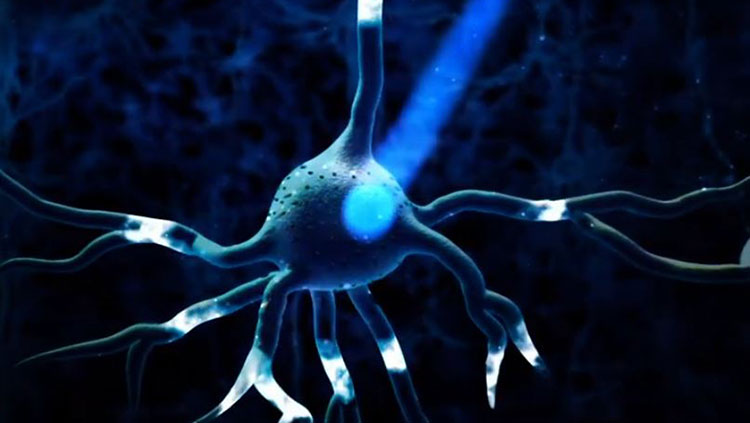
Optogenetics allows researchers to make cells light-sensitive through genetic modification. They can then use light to control the activity of modified cells, including neurons. This approach opened new opportunities to study how specific nerve cells function and for manipulating them directly. In animal models, neuroscientists can directly tinker with brain cells in circuits and regions involved with memory, behavior, and emotion.

The road to this discovery began when Hegemann and his colleagues attempted to parse the cellular machinery allowing the algae Chlamydomonas to have a notably swift response to light stimuli. After Japanese researchers mapped Chlamydomonas’ DNA, Hegemann isolated two genes resembling others known to carry instructions for light-capturing proteins.
Nagel and Hegemann then worked together, identifying two proteins — channelrhodopsin-1 and channelrhodopsin-2 — key to the algae’s ability to respond to light. These proteins are light-sensitive ion channels: openings on the surface of cells for charged ions to travel through, prompting an electrical signal, according to the Nobel Assembly. Deisseroth was the first to insert a protein containing channelrhodopsin-2 genes into rat neurons, causing them to become responsive to light.

In a 2007 study, Deisseroth focused on a group of neurons in the motor cortex of living mice that had been engineered to contain the channelrhodopsin-2-producing gene. Using an optical fiber placed directly into the mouse’s brain, they delivered light directly to these cells, allowing them to control the mouse’s whisker movements.
Researchers similarly use optogenetics today to directly influence neurons, and the tool has also allowed them to shed light on previously unknown inner workings of the brain, paving the way to myriad discoveries including new cell types and circuits governing specific functions. Optogenetics is credited for new insight into the mechanics of brain conditions like autism and schizophrenia, and it could be implemented as a tool to improve medical treatments.
About the Author
.jpg)
Bella is the Staff Writer and Editor for BrainFacts. She previously worked as a digital science reporter at PBS NewsHour, where she was named a fellow in the 2022-2023 class of the National Science-Health-Environment Reporting Fellowships (SHERF) and earned a 2021 D.C. Science Writers Association Newsbrief Award for writing. She graduated from the University of Michigan with a bachelor's degree in 2018.
CONTENT PROVIDED BY
BrainFacts/SfN
References
The Nobel Assembly at Karolinska Institutet. (2026, Oct. 5). Light-seeking algae gave us a switch for nerve cells. [Press release]. https://www.nobelprize.org/prizes/medicine/2026/press-release/
The Nobel Assembly at Karolinska Institutet. (2026, Oct. 5). A light-sensitive algal protein energised neuroscience. [Popular information]. https://www.nobelprize.org/prizes/medicine/2026/popular-information/