Neuroscientist’s Art Highlights Social Behavior Across Species
- Published9 Apr 2026
- Author Bella Isaacs-Thomas
- Source BrainFacts/SfN
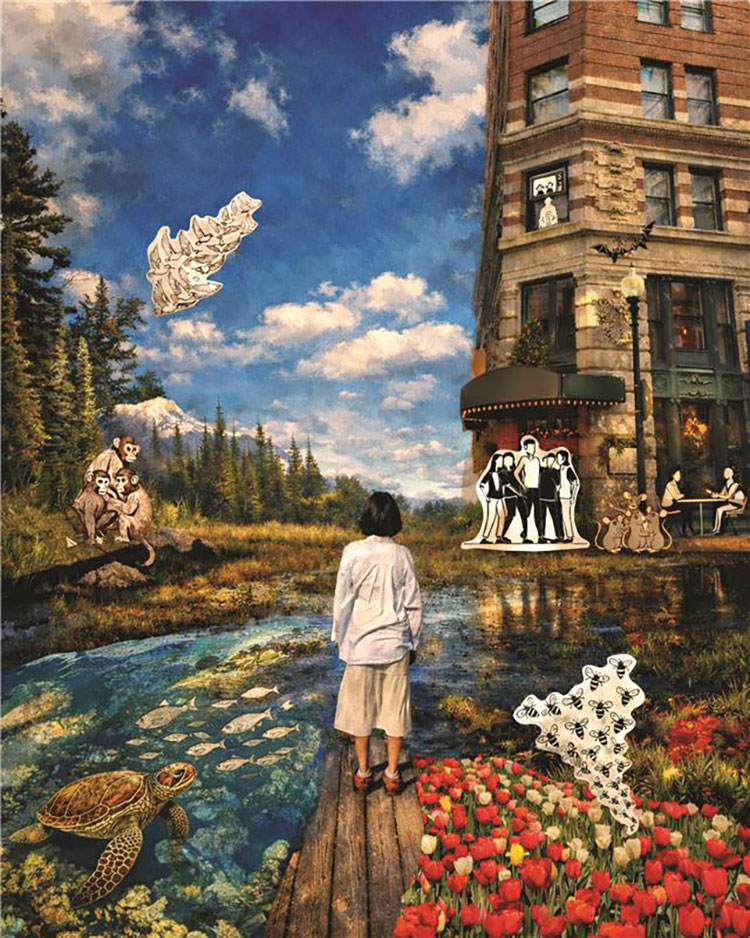
This image, featured on the Feb. 25, 2026, cover of The Journal of Neuroscience, features a dream-like, collaged landscape of a person observing animals interacting with other members of their species. It was designed by SeungHyun Lee, a postdoctoral research fellow at Harvard Medical School and Massachusetts General Hospital. He co-authored a review article detailing the value of studying the neurological basis of group social behaviors in a range of animals, and how those insights can in turn benefit human health.
Lee constructed the image using a combination of his own photography plus illustrations of bees, monkeys, birds, and other creatures he drew for the review. At the center is his wife, who at the time was pregnant with their son. As Lee describes, she’s looking out over a “psychedelic” version of the world, pairing views from nature alongside the human-built environment. Lee created the painted effect after stitching the visuals together in Photoshop and then deploying ChatGPT.
The survival of a huge swath of the animal kingdom hinges on social relationships. When members of the same species come together to make decisions, collective social behaviors emerge from the bidirectional relationship between organisms interacting with the external world and the interiority of their brains. “The individual can affect the group,” Lee said, “and also the group can be affected by the individual.”
The paper points out examples of animal behaviors requiring buy-in from multiple — sometimes even dozens or hundreds of — individuals. Schools of fish synchronize their movements as they swim. Birds coordinate to fly together to a specific location. Rodents work together to solve problems.
Lee emphasized the value of studying a wide variety of animals because each one offers different features and capabilities. You can only fit so many mammals or primates in a lab setting, he noted. Insects, however, offer the chance to see how a much larger group of animals behaves together.
Lee said he was inspired by the ultimate goal of many researchers in this field, which is to contribute to our understanding of how our own brains work and benefit humanity — that’s why he centered his wife in the image. He believes the future of the field will focus on how multiple brain regions collaborate when social behaviors are in action, and what that pathway looks like in real time.
About the Author
.jpg)
Bella is the Staff Writer and Editor for BrainFacts. She previously worked as a digital science reporter at PBS NewsHour, where she was named a fellow in the 2022-2023 class of the National Science-Health-Environment Reporting Fellowships (SHERF) and earned a 2021 D.C. Science Writers Association Newsbrief Award for writing. She graduated from the University of Michigan with a bachelor's degree in 2018.
CONTENT PROVIDED BY
BrainFacts/SfN