What the Wine World Teaches Us About Taste (and Smell)
- Published15 Jul 2026
- Author Bella Isaacs-Thomas
- Source BrainFacts/SfN

Before anything makes it to our mouths, all drinking and dining experiences start with our eyes. In the case of wine, tasters consider the color and opacity of the liquid before them, and swirl it around to assess its legs, or the streaks the liquid leaves on the side of the glass. Then, they raise it to their noses and inhale deeply for the bouquet, parsing which scents they glean. Finally, it’s time to take a sip.
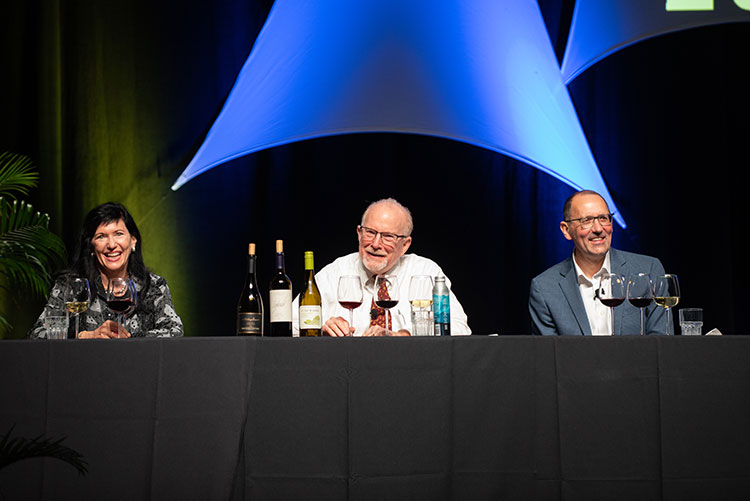
You may picture a wine tasting taking place on a sunny day alongside rolling hills of vines peppered with ripe grapes. But the opening lecture of Neuroscience 2025, the Society for Neuroscience’s annual meeting, featured a comparatively atypical sight: four neuroscientists on a brightly-lit stage tasting and reflecting on a handful of wines at 10:00 a.m. in the San Diego Convention Center.
While the novice wine taster considers their experience purely from a sensory perspective, the expert juxtaposes what their palette tells them with an extensive knowledge of the wine production process. Regardless of expertise, the act of tasting itself employs an extensive network of neurological processes. The sensory input of sight, taste, and smell combines with previous experiences, personal preferences, plus the use of language to describe one’s own opinion and compare it with others.
“In an age where much of our mental activity is passive consumption of digital content, wine tasting demands active participation.” — Nicolas Quillé
At Neuroscience 2025, the neuroscientist-led tasting followed a presentation in which winemaker Nicolas Quillé detailed the extensive time and effort needed to acquire expertise in the wine world. This multi-faceted mental exercise, Quillé believes, is part of what makes wine tasting unique.
“In an age where much of our mental activity is passive consumption of digital content, wine tasting demands active participation,” Quillé said during his lecture. “It requires us to slow down, to focus intensely, and engage us with something real.”
What happens when we taste wine?
Cognitive neuroscientist Rachel Herz participated in the wine tasting panel following Quillé’s lecture alongside fellow neuroscientists Christophe Bernard — who serves as editor-in-chief of the publication eNeuro — and former Society for Neuroscience president John Morrison. She said no two wine tasters have an identical experience with the same wine due to natural variations in their individual sensory physiology.
This is particularly true in the case of olfaction because smells can take two different paths to our olfactory system — either through the nose or through the back of the mouth. For this reason, smell is closely linked to taste. Olfactory sensory neurons dotted within a small patch of mucus membrane atop each nostril — called the olfactory epithelium — are equipped with receptors tailored to specific scents, and these receptors vary from person to person. This means “everyone literally has a unique nose,” Herz said.
Herz offered the example of a wine with prominent notes of green pepper. If a taster has olfactory receptors that are particularly attuned to this compound, she said they may be overwhelmed by — and therefore not very keen on — wines prominently featuring it. A taster possessing a different assortment of receptors may have a completely different experience of the same wine because they don’t get a big boost of this singular chemical profile within the wine complex. An expert with this sensitivity, however, could possibly learn to ignore its influence.
“A master sommelier who happened to be olfactorily very sensitive to green pepper compounds may be able to override a perceptually negative response due to their training and knowledge of what the flavor profiles of particular vintages are supposed to be, and therefore their cognitive analysis would positively modulate their basic sensory perception,” Herz explained.
It’s not all about the nose. Wine tasting involves a combination of our vision, smell, taste, and other senses. Herz explained the trigeminal nerve processes the temperature of the liquid, plus its astringency and general mouthfeel, in concert with touch receptors in the mouth. Smell is processed in the amygdala-hippocampal complex in the piriform cortex, she added. The basic sensations of taste — sour, sweet, bitter, salty, and umami — are processed in the anterior insula.
These signals are then integrated and processed within the orbitofrontal cortex to generate the flavor of the wine itself. This region is also responsible for “coding” the value of the experience as good or bad, Herz explained. From there, many other parts of the brain enter into the fray as tasters recall prior events, communicate their opinions, and respond to the social context of the setting. A wine may even raise a strong emotion or specific memory because smell is closely linked to these processes.
“The taste of sour isn't recalling any specific memory. It's the experience of the aromatics with the mouth sensation and everything else that's going on that then is bringing you back to, let's say, when you first had a sip of wine with your grandfather when you were eight,” Herz said.
What we bring to the table
Countless factors inform how a person encounters a specific wine. Heber Rodrigues, a sensory perception scientist based at the University of Surrey, describes a “bottom-up” process starting the moment the liquid hits our senses and instantly sends information to the brain, creating a sense of anticipation. From there, a “top-down” process kicks in that combines previous experience and level of expertise to generate our personal interpretation of the wine we’ve just tasted.
“Because of this, the wine is not only chemical — [essentially, it] is psychological,” Rodrigues said.
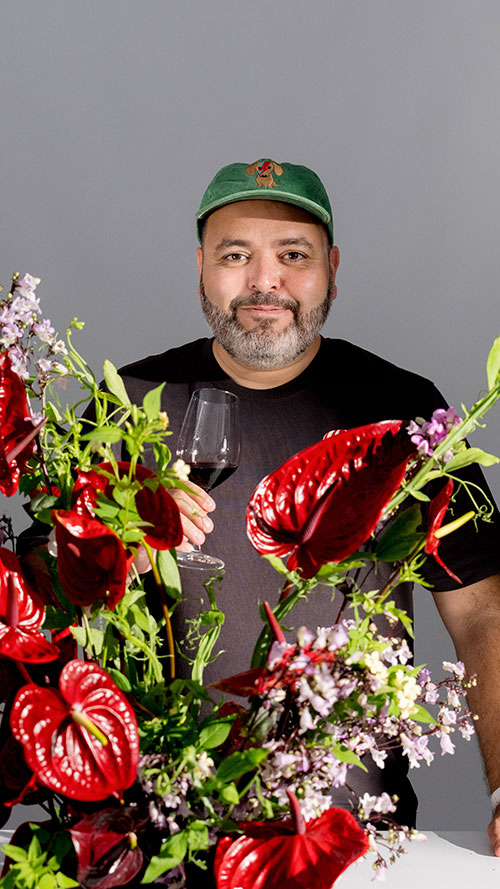
The wine world offers plenty of insight as to how expectation and mindset can override or even contradict the senses. A 2001 study, for example, demonstrated how dyeing white wine red caused tasters to erroneously describe it as having the qualities of a red wine. In his research, Rodrigues seeks to override the “prototypes,” or preconceived notions people bring to tasting, by putting the liquid in black glasses so participants must solely reflect on the input they get from their tongues and noses.
Culture and language can also influence how a person self-reports their wine drinking experience. Rodrigues conducted a study in which Japanese and English participants tasted the same white wine. Japanese tasters described it as evoking lychee, while English ones said it had a rose-like quality. Turns out, the wine contained the molecule rose oxide, which is found in both roses and lychees. Both groups reported an accurate analysis, but they brought their own unique frames of reference to the table.
How knowledge influences expectation
Acquiring expertise around wine can be a fun and engaging process, but it can also present some drawbacks. Herz noted that as intermediate tasters develop their skillset around identifying flavors and notes to describe wine, this analytical process somewhat eclipses the holistic one of the tasting itself. This “verbal overshadowing,” she explained, can disconnect a person from the basic pleasure of trying a new wine.
Knowing more about the wine production process — such as which grapes are grown in specific regions and what it takes to make different varieties — can also contribute to incorrect, if not outright unfair, expectations. A decade ago, Rodrigues and his team asked professional wine traders for their thoughts on wines that come from Brazil, Argentina, France, and Switzerland. They then had the traders taste wines from each country without knowing their origin.
Despite previously giving Brazilian and Argentine wines higher conceptual ratings during the blind taste test, participants' evaluations changed once the country of origin was disclosed. Likeability ratings for wines from Argentina and Brazil decreased under informed conditions, while French and Swiss wines received more positive evaluations than before. Rodrigues said the findings suggest that knowledge of a wine's origin can activate stereotypes or preconceived beliefs, influencing not only overall liking but also how people perceive and describe sensory characteristics.
Although the extent of their impact may vary, Rodrigues added novice and expert tasters alike can be influenced by “extrinsic factors” like where a wine was made or the bottle it comes in. Herz also pointed out people who are newer to wine tasting may have trouble trusting their own sensory experience, deferring instead to the authority of an expert.
If the idea of furthering your expertise on the subject of wine appeals to you, Herz suggests heeding a piece of advice she received from an instructor during a tasting course as you develop your knowledge and palette: “The wine that you like is the wine you should drink.”
About the Author
.jpg)
Bella is the Staff Writer and Editor for BrainFacts. She previously worked as a digital science reporter at PBS NewsHour, where she was named a fellow in the 2022-2023 class of the National Science-Health-Environment Reporting Fellowships (SHERF) and earned a 2021 D.C. Science Writers Association Newsbrief Award for writing. She graduated from the University of Michigan with a bachelor's degree in 2018.
CONTENT PROVIDED BY
BrainFacts/SfN
References
Morrot, G., Brochet, F., & Dubourdieu, D. (2001). The color of odors. Brain and Language, 79(2), 309–320. https://doi.org/10.1006/brln.2001.2493
Herz R. S. (2004). A naturalistic analysis of autobiographical memories triggered by olfactory visual and auditory stimuli. Chemical Senses, 29(3), 217–224. https://doi.org/10.1093/chemse/bjh025
Herz, Rachel. (2017) Why You Eat What You Eat: The Science Behind Our Relationship with Food. W. W. Norton & Company.
Rodrigues, H., & Parr, W. V. (2019). Contribution of cross-cultural studies to understanding wine appreciation: A review. Food Research International (Ottawa, Ont.), 115, 251–258. https://doi.org/10.1016/j.foodres.2018.09.008
Rodrigues, H., Rolaz, J., Franco-Luesma, E., Sáenz-Navajas, M. P., Behrens, J., Valentin, D., & Depetris-Chauvin, N. (2020). How the country-of-origin impacts wine traders' mental representation about wines: A study in a world wine trade fair. Food Research International (Ottawa, Ont.), 137, 109480. https://doi.org/10.1016/j.foodres.2020.109480