How Does the Brain Control Itself?
- Published6 May 2026
- Author Bella Isaacs-Thomas
- Source BrainFacts/SfN
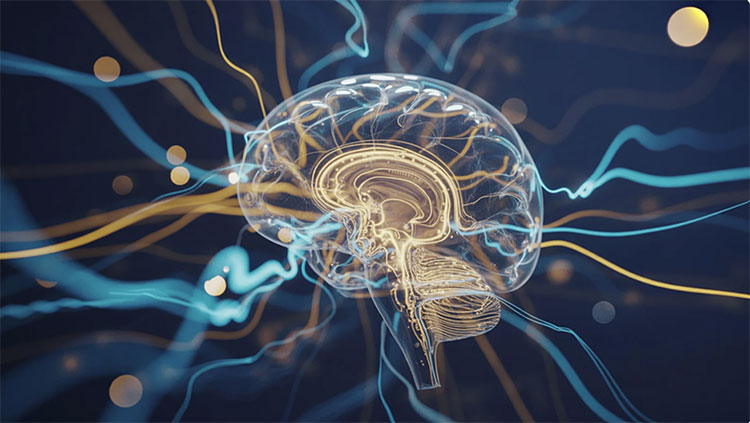
Our brains receive a constant firehose of input from the outside world. They’re also tasked with squaring this data with all the information we’ve learned throughout our lives to govern the behaviors, decisions, and thoughts we experience in real time. Researchers still don’t fully understand how the human mind pulls off this complex feat of cognition, but their theories contribute to an ever-evolving picture of the mechanisms making it possible.

Earl Miller, the Picower professor of neuroscience at the Massachusetts Institute of Technology, studies cognition and consciousness. He and his colleagues propose a novel explanation for how the brain controls itself, a concept called executive control. It builds upon the long-established understanding of connectivity, or how hard-wired connections between neurons drive activity across the brain.
Miller’s theory starts with the prefrontal cortex — the brain region in charge of parsing the concepts and patterns we come across in life. This information is filed across the synaptic connections between millions of neurons in the cortex, many of which carry out various tasks like “utility players on a baseball team,” Miller said. Coordinating a new thought or action requires the brain to quickly and efficiently activate these neurons, a feat he believes requires a key organizing force: brain waves.
“Your cortex is like an exquisitely elaborate set of trumpet mouthpieces that can sound notes based on information it's stored,” Miller explained. In reality, these musical “notes” are the electrical activity neurons produce, which in turn generate brain wave patterns. These waves collide with the sensory input coming in from our environment — like the sound waves from a car driving by, or the electromagnetic waves of light bouncing off a painting and reaching the eye — to spur conscious thought.
Miller says this dynamic goes both ways. The new waves created during this interaction also influence neuronal activity, allowing new information to be baked into the brain for later use. He compares this phenomenon to placing sand on a speaker and observing how the individual grains rearrange themselves in response to the sound being played. In the brain, electrical waves serve as a comparable organizing force, coordinating the electrical activity among neurons in the cortex.
The collaboration between brain waves and neuronal connections creates a kind of “cognitive stencil,” or situation-specific set of instructions telling our cortex how to process information. It also allows the brain to actively utilize its own background knowledge as it carries out executive control.
BrainFacts spoke with Miller about his work, how the brain computes information, and how human and artificial intelligence differ.
What is cognition, and how does it differ from consciousness?
I think consciousness is one end of the distribution of cognition. Not all cognition is conscious. Cognition to me is the brain taking charge of its own thoughts. Any simple creature can swim toward food or swim away from a predator. But we have our own goals and our own plans, and the environment doesn't just act on us. We act on the environment. To do that, your brain needs to take control of itself.
Most of the cognition and decisions your brain is making is actually at the unconscious level. A lot of the time, consciousness is kind of along for the ride. In fact, things don't even reach conscious awareness until about half a second after they happen. So consciousness is really good for countermanding, or stopping your brain from doing something stupid it just decided to do. It's also good for planning your behavior. I can plan my day and think about what I'm doing in "X" number of minutes or days or weeks and years into the future without having to [immediately] go and do it.
Analog computing involves combining wave-based input from the environment with waves generated within the brain to process information. How does the brain do this?
Analog computing is doing math with waves. Imagine two sine waves moving past one another. When they line up together, you get a sine wave that's double in size. And when they oppose one another, they flatten out. You've just done addition and subtraction with two sine waves, and that's one frequency in one dimension. Your brain does this in three dimensions, so that's a lot of computational space to do math.
Digital computing breaks down the world in a bunch of ones and zeros, [which is not efficient]. The world is not ones and zeros — the world is analog. [The real efficiency with analog computation] is because [when] the waves come together, the entire equation gets solved in parallel. That is a huge, huge, huge computational, energy-efficient benefit over digital computing. Because with digital computing, if you want to solve a long equation, you’ve got to do it one step at a time.
They're building nuclear [and electric power plants] to power these AI data centers because AI requires enormous amounts of energy. Biology does not solve problems by throwing energy at it. Biology solves problems in energy-efficient ways, and I think it’s because your brain does it with analog computing. And that's why your brain runs on 20 watts — the power of a dim light bulb — instead of a nuclear power plant.
How does human consciousness differ compared to other animals or AI?
AI responds to inputs. Your brain works in a very different way. Your brain has a constant narrative going on. That's what a lot of these waves are doing. They're constantly setting the tone, providing this top-down influence continually in your brain, even when there's no overt sensory input.
We have our inner narrative going on and we occasionally check into the outside world, whereas AI just responds to inputs. People think “Oh, maybe AI is conscious, maybe it's going to become conscious, maybe it's conscious already.” Maybe, but we’ve got to define what consciousness is then. Because if we put our consciousness inside AI, we would not recognize it as anything like human consciousness.
Take an octopus, for example. Octopuses [can] open up jars and stuff like that. Maybe an octopus is conscious. However, its nervous system is nothing like ours. Its nervous system is like eight little nervous systems down its arms. So, if we took your consciousness and put it in an octopus, you would not recognize anything you're familiar with at all.
[It’s] easier to study if we start with something familiar. Since we know so little [about consciousness in general], just define it in terms of something we're familiar with: human consciousness. I'm not saying that other creatures don't have consciousness. I'm saying let's start with human consciousness and then move on from there.
About the Author
.jpg)
Bella is the Staff Writer and Editor for BrainFacts. She previously worked as a digital science reporter at PBS NewsHour, where she was named a fellow in the 2022-2023 class of the National Science-Health-Environment Reporting Fellowships (SHERF) and earned a 2021 D.C. Science Writers Association Newsbrief Award for writing. She graduated from the University of Michigan with a bachelor's degree in 2018.
CONTENT PROVIDED BY
BrainFacts/SfN
References
Buschman, T. J., & Miller, E. K. (2007). Top-down versus bottom-up control of attention in the prefrontal and posterior parietal cortices. Science (New York, N.Y.), 315(5820), 1860–1862. https://doi.org/10.1126/science.1138071
Lundqvist, M., Brincat, S. L., Rose, J., Warden, M. R., Buschman, T. J., Miller, E. K., & Herman, P. (2023). Working memory control dynamics follow principles of spatial computing. Nature Communications, 14(1), 1429. https://doi.org/10.1038/s41467-023-36555-4
Miller, E. K., & Cohen, J. D. (2001). An integrative theory of prefrontal cortex function. Annual Review of Neuroscience, 24, 167–202. https://doi.org/10.1146/annurev.neuro.24.1.167
Rigotti, M., Barak, O., Warden, M. R., Wang, X. J., Daw, N. D., Miller, E. K., & Fusi, S. (2013). The importance of mixed selectivity in complex cognitive tasks. Nature, 497(7451), 585–590. https://doi.org/10.1038/nature12160