What if you had the power to manipulate time?
Like everything we perceive, time is not a fixed reality. It’s constructed — and reconstructed — by our brains. This video explains why the same hour can disappear when you’re spending time with friends but drag through an uneventful afternoon.
This video won the People's Choice award in the 2026 Brain Awareness Video Contest.
Created by Denise Ching Yee Cheah
CONTENT PROVIDED BY
BrainFacts/SfN
Transcript
Let's talk about time.
And I'm not talking about the absolute time that is read off the hands of a clock. I'm talking about our subjective experience of time.
You see, time perception is interesting as there is no dedicated sense organ for time. The brain does not receive a time signal in the same way that our eyes get light or our ears get sound.
Instead, our experience of time is constructed through a combination of sensory information and neural systems.
Think of it like this: Time isn't like a river that flows constantly. Instead, it's like a train that lays its own tracks, with the brain building your sense of time based on the internal environment and the external world.
This means that your sense of time is highly malleable and prone to distortions.
You've probably experienced it yourself.
When you're waiting, or bored, time seems to drag on forever. But when you're having fun, or in the zone, time just seems to fly by and disappear altogether.
In the lab, researchers can unpack the mechanisms underlying time perception by asking participants to make different judgments about time.
In prospective timing, you'll know in advance that you'll have to judge how long something lasts. For example, between two sounds: “beep, beep.”
We're able to keep track of time extremely well during these situations, which suggests that perhaps there is an internal timer within us.
This internal clock mechanism is most often defined by a pacemaker-switch-accumulator system.
The pacemaker produces regular pulses, like the hands of a clock ticking, and the accumulator collects these pulses.
The more pulses are accumulated for a given duration, the longer time is perceived, and we overestimate the length of an event.
This counter framework has been connected to an embodied perspective of time perception.
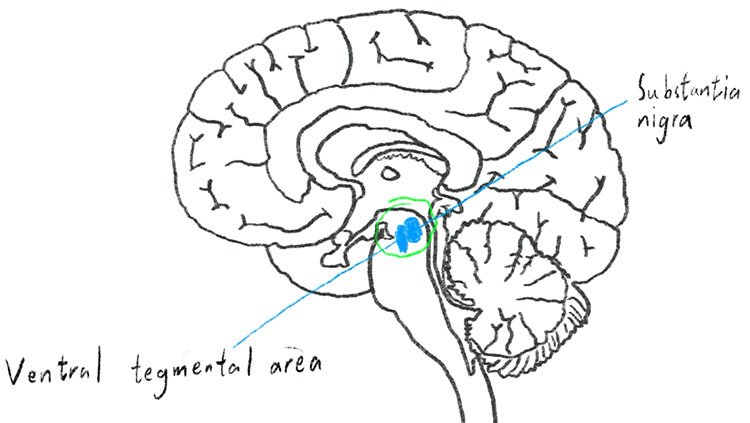
Specifically, the rate of the pacemaker is influenced by changes in bodily states, which may be represented through arousal. For example, through increasing body temperature, or effective levels of dopamine in the brain.
When arousal is heightened, the pacemaker accelerates, leading to more pulses accumulated for the same physical unit of time.
Emotions, too, seem to influence time perception through arousal.
When we feel fear, such as during accidents or threat, we describe time as slowing down or even freezing.
The fearful event is judged to last longer as heightened arousal increases clock speed.
Simultaneously, emotions also influence attention.
In the face of danger, we need to track time accurately to know how to act as soon as possible.
Here, time lengthens as a function of attention.
Attention is said to act as the gate between the pacemaker and accumulator.
The more attention is directed to time, or temporal information, the wider the gate opens, the more pulses are collected, and the longer time feels.
When you're bored or waiting on something, time is highly relevant, and therefore seems to drag.
When you're having fun or enjoying yourself, time flies by as your attention is directed elsewhere.
Interestingly, when we judge time as it passes, it can feel completely different afterwards.
Periods of boredom, or waiting, can drag in the moment, yet seem brief and almost empty later on.
On the other hand, a busy day feels distant in the past.
Time perception here relies less on the internal clock and more on how memory encodes events.
In what's known as retrospective timing, your brain does not monitor clock ticks in real time. Instead, it keeps track of the events you've experienced and encoded into memory.
The more events, or temporal markers, that are remembered, the longer a duration is perceived to be.
So the eventfulness of your day out creates many conceptual changes and leaves a dense record of events in memory.
When these events become familiar, they are less meaningful markers, and take less time to process.
When every day looks the same, life runs on autopilot and predictability compresses time.
But as I mentioned, our experience of time is constructed in the brain.
It may not be a time machine, but supposing that our experience of time is reality, we can effectively make our days feel longer or shorter.
Want time to pass quickly?
Get absorbed in something that energizes you. Or do something fun, and let your attention drift away from the clock.
Want time to pass slower and feel fuller and longer?
Seek variety and new experiences to create more meaningful memory markers and expand time.